
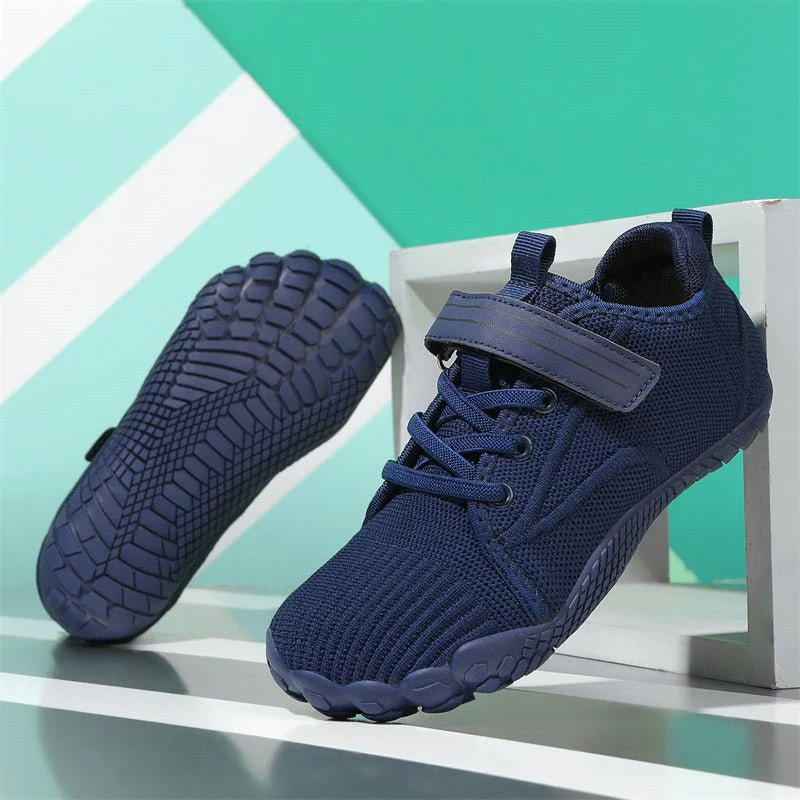
A child’s foot is not a miniature adult foot. It is a structure in full development, with its own anatomical characteristics and a plasticity that makes it particularly sensitive to external influences, including those of footwear. Barefoot shoes for kids address this with a proposition centered on the natural development of the child’s foot, in contrast to many traditional children’s shoes that replicate the problematic features of adult footwear at a smaller scale.
Table of Contents
How the foot develops in the early years of life
At birth, a baby’s foot is composed predominantly of cartilage. Progressive ossification occurs throughout childhood and is complete approximately around the age of 18 to 20 years. This structural plasticity is an evolutionary advantage, because it allows the foot to adapt and model itself according to the stresses it receives. But it is also a vulnerability: incorrect stresses, such as those imposed by inadequate footwear, can influence development in a permanent way.
Pediatricians and podiatrists agree on several fundamental principles for children’s foot health: freedom of movement, adequate proprioceptive stimulation, sufficient space for the toes to move and grow, and a gradual progression from being barefoot to wearing shoes as the child begins to walk and frequent environments that require foot protection.
Why traditional children’s shoes can be problematic
Children’s footwear traditionally sold in shops often replicates features borrowed from adult shoes that have no justification in infant physiology.
Narrow or pointed toe boxes compress the toes at a stage when the bone structure is still malleable, potentially contributing to deformities such as hallux valgus that will manifest in adulthood. Rigid soles restrict the natural movement of the foot and reduce proprioceptive stimulation that is fundamental for developing a sense of balance and motor coordination in the child. Arch supports inserted in many children’s shoes are often counterproductive: the plantar arch in young children is naturally flat and develops gradually through movement and muscle growth. Supporting it artificially before this development occurs naturally may interfere with the process.
What informed parents look for
A parent who researches children’s foot health arrives almost inevitably at the same conclusions that led to the creation of the barefoot shoes for kids market.
The ideal shoe for a child must have a sole that flexes in all directions, allowing the foot to move naturally during walking and running. It must have an anatomical shape with adequate space for the toes, without lateral compression. It must be lightweight, so as not to add weight that alters movement mechanics. It must have minimal or zero drop, keeping the foot in a horizontal position relative to the ground.
These are not luxuries or aesthetic preferences: they are functional requirements for footwear that respects the physiology of children’s development.
Practical considerations for parents
Choosing barefoot shoes for children requires some practical awareness worth knowing.
Sizing is critical and must be checked frequently: a child’s foot grows rapidly, and a shoe that has become too small can cause more harm than a structured shoe if it limits toe space. The general rule is to leave approximately one centimeter of space between the tip of the foot and the front of the shoe.
Adaptation is simpler for children than for adults, because children do not have years of footwear habits to re-educate. A child who begins walking directly with minimalist shoes or barefoot indoors adapts naturally and without the transition issues typical of adults.
Durability is a practical factor to consider: children are intensive users of their shoes. Materials and construction must be adequate for energetic use, with abrasion-resistant soles and robust stitching.
An investment in future health
Choosing barefoot shoes for children is not simply an aesthetic or ideological preference. It is a choice that can have concrete and measurable effects on foot development and postural health over the long term. A foot that develops freely, with adequate stimulation and without artificial compression, has the best chance of becoming a strong, mobile foot capable of supporting the body for a lifetime.